Former Minister of State in charge of Finance and Chairperson of Parliament’s Public Accounts Committee, Abena Osei-Asare, is demanding a full-scale investigation into the operations of the Ghana Gold Board (GoldBod) following revelations about massive losses linked to Ghana’s gold purchase programme.
Her call was captured in a video report posted by TV3 Ghana on Facebook on August 11, where the channel headlined the story as “$1.7BN GOLDBOD REPORTED LOSSES”.
In the clip, the MP for Atiwa East is seen in her office urging President John Dramani Mahama to initiate what she describes as “proper and further investigations” into GoldBod’s operations.
Speaking calmly but firmly, Osei-Asare said she was only temporarily relieved that the Bank of Ghana has stopped funding GoldBod from July 1, 2026. She reminded President Mahama of his own pledge earlier in the year when he engaged State-Owned Enterprises and warned that loss-making SOEs would be closed or merged.
“Mr. President, walk the talk and investigate GoldBod.”
Her argument is anchored on two points:
1. The scale of spending: She cited that Ghana spent about $900 million from the Bank of Ghana and an additional $297 million from the Ministry of Finance on GoldBod in the last quarter of 2025 alone – about GH¢4.5 billion.
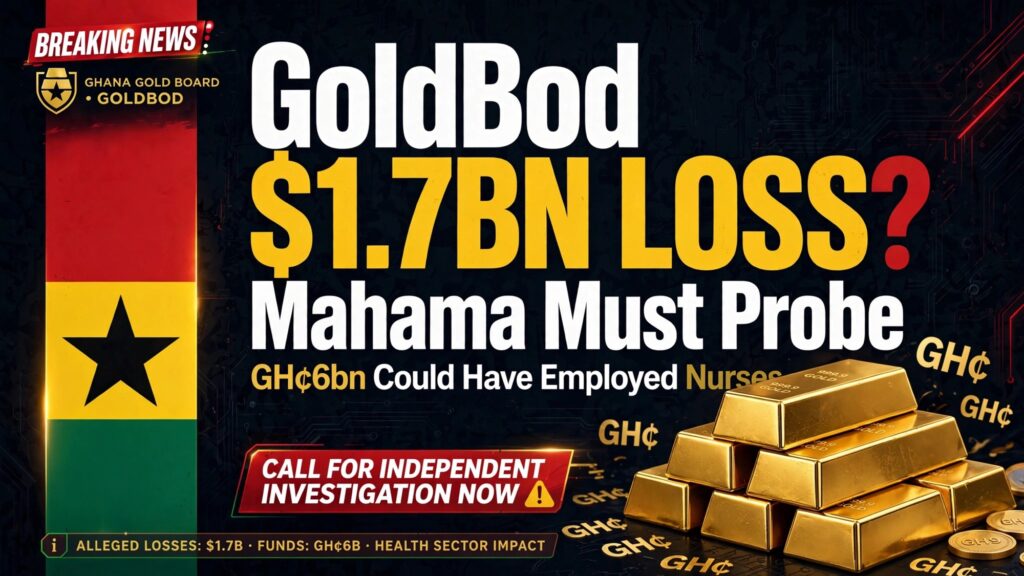
2. The IMF figure: According to the IMF’s 5th review under Ghana’s ongoing programme, the Domestic Gold Purchase Programme (DGPP) helped shore up reserves but also generated financial losses of about $1.7 billion, equivalent to 1.5% of GDP. The Fund noted that losses weakened BoG’s balance sheet through assay costs, fees paid to GoldBod, and discounts on gold sold to exporters.
Osei-Asare’s twist that has gone viral is the social cost. She argues that GH¢6 billion of that reported loss — the cedi equivalent of part of the dollar loss reflected in BoG’s books — could have been used to recruit thousands of unemployed nurses and midwives who have been picketing for postings, despite government introducing over eight new taxes.
In the TV3 Facebook graphic, the channel summarized her demand as calling for “clarity over discrepancies between BoG losses & IMF report” — a point she hammered in Parliament when she challenged the BoG Governor to show where the losses are recorded in the audited accounts.
GoldBod’s Response: “Not Our Loss”
GoldBod CEO Sammy Gyamfi has strongly rebutted the linkage.
Speaking on Joy FM’s Super Morning Show, Gyamfi said Osei-Asare was conflating two different programmes.
“Bank of Ghana made a loss under the Domestic Gold Purchase Programme. That programme is Bank of Ghana’s programme.”
He revealed that BoG itself recorded a GH¢6 billion loss under the same programme in 2024, before GoldBod even started operations.
According to Gyamfi, the Ministry of Finance money was not a bailout but a revolving seed capital of GH¢4.5 billion approved in the 2025 Budget and only hitting GoldBod’s account on December 30/31, 2025. He claims GoldBod in fact declared an operational surplus of GH¢909 million from internally generated funds and an overall surplus of GH¢5.4 billion when government revenue is included, with no adverse findings from the Auditor-General.
The Ghana Gold Board itself issued a statement clarifying that the IMF described the figure as a quasi-fiscal loss, not a realised operational deficit borne by GoldBod.
IMF Communications Director Julie Kozak, in a Washington briefing, acknowledged both costs and benefits:
“On the benefit side, what we see is a contribution to a buildup of international reserves and reduced pressure on the foreign exchange market during a difficult period for Ghana.”
The Fund advised that future costs should be reflected transparently on the national budget rather than on BoG’s balance sheet.
There is also confusion over numbers. While the $1.7bn figure refers to the cumulative cost of the entire DGPP since inception, the IMF in its latest review put losses from the artisanal small-scale doré component alone at $214 million as of Q3 2025.
Why This Matters
The GoldBod debate is no longer just accounting:
1. Fiscal transparency: Osei-Asare’s PAC role gives her call weight. She wants the Auditor-General and Parliament to reconcile BoG’s GH¢9.1bn reported net loss with IMF’s dollar figures.
2. Social spending trade-off: Framing GH¢6bn as nurses’ salaries makes the abstract loss concrete for Ghanaians facing unemployment in the health sector.
3. Political accountability: As seen in the TV3 comments section, reactions are deeply polarized, with many questioning Osei-Asare’s moral authority given her role as deputy to Ken Ofori-Atta, while others insist $1.7bn is public money that must be accounted for regardless of who raises it.
What to watch next
• The stakeholder meeting announced by the BoG Governor after his PAC appearance, expected to include GoldBod, BoG and Ministry of Finance, to reform the DGPP.
• Whether government, from July 2026, will indeed absorb GoldBod-related quasi-fiscal losses onto the budget as recommended by the IMF.
• Publication of GoldBod’s Q1 and Q2 2026 audited statements on its website, which Gyamfi says will prove surplus, not loss.
For now, the TV3 video has reignited a necessary conversation: Ghana’s gold is supposed to be a stabilizer, not a sinkhole. As Osei-Asare puts it, even small gold sellers around town don’t sell at a loss — so why should a national aggregator?
Watch the full TV3 Ghana report on Facebook here and the extended press statement video here.